
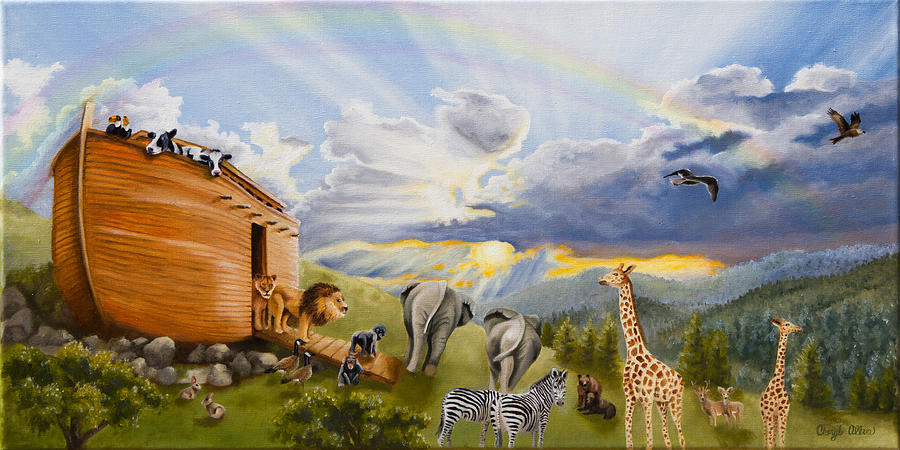
None of us will ever adequately understand why God decimated humanity with a flood. When I was a child I loved the reading of Noah because the flood was so exciting, like a Hollywood movie (which it would later become, thank you Russell Crowe). As I got older the implications of the annihilation of the entire human race save one family became clear.
We will also never adequately understand the meaning of God regretting that he created humanity since “humankind’s thoughts are of wickedness the entire day.” Are we really that bad?
And finally, we’re never going to be fully impressed with a Noah who allowed humanity to be extinguished – never offering even one objection to God’s plan, as will Abraham and Moses in the future – so long as he can save his and his family’s hide.
But here is one over-arching thought that might help.
Humans are not wicked. To the contrary, they are generous and caring and receive gratification from altruism.
But they can be easily corrupted. Even good people.
We hardly bat an eyelash these days when we hear of a Priest abusing a child or a Rabbi arrested for voyeurism. Worse, we’re not at all surprised by terrorists who murder in the name of God. Our expectations, even for members of the clergy, are low.
Religion seems to offer no real protection against corruption.
So what does?
Only one thing.
The Law.
No matter how much any of us believes in the goodness of human nature, we would never agree to live in a country without a police force enforcing laws passed by a legislature. Countries like that are jungles. Living in them is rolling the dice with your life.
We can have a positive, upbeat belief in human nature. But we should only trust the law.
It sounds boring and unromantic. Indeed, Judaism as a religion has been pummeled by so many of its critics – most notable St. Paul – for having as its foundation the Law of Moses.
But the law is what safeguards humanity from murder, theft, and self-immolation. That’s why God did not give the Ten Sentiments, or the Ten Beliefs, or the Ten Suggestions. He gave The Ten Commandments, thereby establishing that whatever else religion must be its foundation is always the law.
Any society or cleric that accepts the law as the essence of religion and submits to its authority will drastically reduce the chances of corruption.
There is corruption in America. But it’s a pittance compared to, say, Russia or even Mexico. The difference is that in our country the law is enforced, even against the mighty and the powerful.
Last month I was invited to address 100,000 people in Seoul’s Olympic Stadium along with religious and political leaders from around the world. I sat next to the former President of Bosnia. I brought up Sarajevo and the 100th anniversary of the assassination of Archduke Franz Ferdinand by Gavrilo Princip, which sparked the First World War. I told him I had seen the cell where Princip was held after the assassination in what would later become the Theresienstadt Concentration Camp.
He told me an extraordinary thing. Princip, only 17 at the time of the assassination, was not put to death, even though he had murdered the heir to the throne. “This just shows how the Austro-Hungarian Empire was a nation of laws. They may have wanted him dead. But there was the law.”
Compare that to the lawlessness, brutality, and genocide that followed in Austria after the Anschluss of Hitler, when laws against murdering Jews and others were not only abolished, but became a mitzvah.
Here is what God regretted. He did not regret creating man, but regretted creating him without the law. OK, Adam and Eve had one law – don’t even from the forbidden fruit – and they broke even that. Still, humankind requires laws to remain moral.
God’s regret then is that since human beings can become corrupt at any moment, since their hearts can easily veer toward wickedness, they need a legal moral structure that safeguards their goodness and protects the rights of others. The world required a Torah, and it would get one: beginning with laws introduced to Abraham and culminating with Moses.
Did God feel that, in the absence of the law, man had become so corrupt that he had to start over? It’s difficult to say, as it would seem justify the genocide of humanity, something that the Torah expressly forbids by virtue of the same Ten Commandments. If you can’t murder even one person, you certainly can’t murder many. Moreover God does not need my defense. He’s more powerful than me. But human beings do.
This is also how I understand the failure of Noah. Noah is a naturally good person. But his goodness is based on personal sentiment rather than adherence to the law. He personally refrains from murder because he finds it wrong and unseemly. He believes theft and adultery are wrong, and doesn’t engage in any of these pursuits. But it’s not based on absolute moral standards. Hence he raises a family committed to the same ideas – personal sentiment – but does not build a society based on these laws. But simply refraining from doing bad doesn’t automatically make you good. I hear people saying this all the time, “I’m a good person. I don’t hurt anyone, I don’t cheat anyone. I certainly don’t kill anyone.” Hang on a second. Because you’re not Charles Manson, does it mean that you’re good? All you’ve really said is that you’re not a bad person.
That’s Noah. He’s not a bad person, and doesn’t hurt anyone. But he doesn’t stick up for anyone, either.
Abraham, however, believes in the law. He believes there should be laws forbidding murder. It needs to go beyond just sentiment. Feelings are individual. Laws are universal. Even God is bound by the law of ‘Do Not Murder’. Thus, Abraham wrestles with God to protect even the corrupt people of Sodom and Gomorrah, demanding that God himself grant absolution.
We’ll learn more about Abraham in next week’s Torah reading.
Rabbi Shmuley Boteach, “America’s Rabbi,” is founder of This World: The Values Network, the foremost organization influencing politics, media, and the culture with Jewish values. The international best-selling author of 30 books, he has just published Kosher Lust: Love is Not the Answer. This is part of regular series on the weekly Torah reading. Follow him on Twitter @RabbiShmuley.